Alien as Metaphor for Rape
About getting rid of cars from city streets.


A few years back, while observing a university lecture, a well-regarded academic was discussing the Alien film series. “As you all know,” he began, “Alien is a metaphor for rape.” In his possible world, he was setting up a conversation between Lieutenant Ellen Ripley, the character played by Sigourney Weaver, and Saint Sebastian, the saint shared by both the Catholic and Orthodox churches: for both Ripley and Sebastian, it’s always about the gesture of the one who says no.
The first problem lay in that opening phrase: “As you all know.” This is an epistemic modalizer, or logical-epistemic marker, used to assume a position of truth, objectivity, knowledge, and certainty: obviously, it’s well-known, of course, it’s clear, no doubt, etc. But here it felt sneakier. Because of the plural you: as you (all) know, Alien is a metaphor for rape. A form of address that led to the second problem. I didn’t know that. Why should I? Is Alien a metaphor for rape? Since when? How did that happen? How does one come to such a conclusion?
My first reaction was the one we tend to have when something disorients or unsettles us: assume everyone else is a moron and double down on the things we know—or think we do. Modalized or not, at least I knew one thing: Alien was not a metaphor for rape.
I left thinking about all of this. I was probably muttering to myself, kicking little stones. Alien could be a metaphor for many things, but not for rape. I was angry. More than that, I was offended. Offended in the sense that I assumed my complete and secure universe—taken for granted, something that just was—had been destabilized. I might not have known who Saint Sebastian was, but I did know Alien well enough. But the more I thought about it, the less I muttered. By the time my walk ended—after recalling the creature forcibly penetrating people, even when they were asleep or unconscious, impregnating them or killing them, forcing victims to give birth against their will, some even resorting to suicide to avoid doing so—I had long stopped kicking little stones and had fully embraced the epistemic modalizer: we all know Alien is a metaphor for rape.
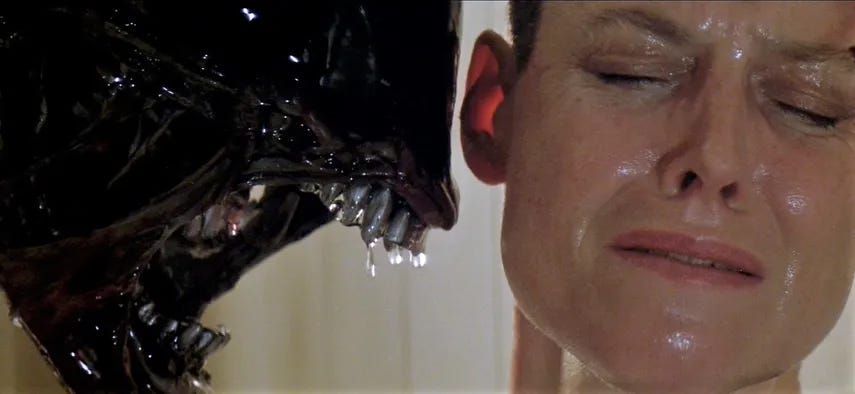
It seemed I hadn’t been paying as much attention as I thought. This was said from the outset. The Ridley Scott film premiered in 1979 and, by the following year, publications, symposiums, studies, books had already built on the premise that, as you know, Alien is a metaphor for rape. But not all of us can know everything. Sometimes we focus on other things. Or we don’t focus at all. We prize jump scares over metaphors—the jolt we feel when the creature bursts from a chest that seemed fine a moment ago.
Thinking of Alien as a metaphor for rape can be a useful strategy for engaging with urban issues. As long as we remove—or at least handle with care—the logical-epistemic modalizers.
Take the issue of getting rid of cars from city streets. The moment you bring it up, you can almost see that familiar expression form on anyone’s face: offense. As though you were telling them Alien is a metaphor for rape. The idea that city streets aren’t for the exclusive use of cars offends some primordial principle of life organization—not in a social or political sense, but in an existential, fundamental one.
Something primordial.
Think of children’s drawings of everyday life, the ones always posted on school walls: an elementary composition—a horizon line, a house above it, a tree beside it, maybe flowers, a dog, the sun in the sky, and a car passing down the street. Calling it a naturalized fact doesn’t do it justice. It’s the very blueprint of the universe. That’s why so many drivers can’t fathom sharing the street with cyclists. Or placing café tables in that narrow strip beside the curb—ground they assume God ordained for cars. Or debating who was at fault after a crossing: someone lost in Alien, or a driver hurtling two tons of metal while glued to their phone—as if both bore the same responsibility, when we know they don’t. None of this makes sense at first glance. The initial reaction to any crack in that self-contained universe is disorientation. Confusion. Muttering. Kicking little stones. Clinging to what they know. Offense over anger.
That’s why it’s useful to think of Alien as a metaphor for rape. Or whichever Alien-is-a-metaphor-for-rape you’ve tucked away. It forces you to remember what it feels like when your complete world begins to crack. It helps you set aside the logical-epistemic modalizer. That’s the first step toward making the changes we want—urban or otherwise—actually change.